All posts by trickster_admin

Governor’s Hurricane Conference Opportunity

2015 Student Conference Scholarship Program

All students interested in Emergency Management in Florida are invited to apply for a Student Scholarship to attend the 29th Annual Governor’s Hurricane Conference®
May 10 – 15, 2015 in Orlando, Florida

Eligibility:

Students currently enrolled in a public or private institution of higher education, at the graduate or undergraduate level, and who have taken or are taking emergency management related courses as part of their academic program, are eligible to apply. While a student’s major or minor concentration of study need not be “emergency management” specifically, they should demonstrate that their field of study has a direct impact to overall emergency preparedness, response, recovery and/or mitigation.

Specific Requirements:

Recent Graduates: Students who complete their degree requirements no more
than 6 months prior to the conference are also eligible to apply.
Florida Residents: Students who are Florida “residents for tuition purposes” (as per § 1009.21, F.S.) will be given priority. Out-of-state or online students may also be considered based upon overall ranking.
Institutional Limits: The total number of students from any single institution
may be limited based on total funding availability.
Prior Recipients: Students who have received a scholarship for a prior
conference are not eligible to apply for another scholarship.
Employment Status: Students who are full-time employees within emergency management or related fields and receive employer benefits are not eligible.

Scholarship Benefits:

The Student Scholarship Program provides complimentary conference registration but does not cover all other expenses related to conference attendance. Funding of other expenses will be based on GHC resources available and the number of applicants who qualify.

Date Conflict Concerns:

If you nave concerns regarding the dates of the GHC conflicting with your curriculum, our Educational Outreach Committee Members are willing to communicate with the faculty
at your institution to help resolve any such issues. If you need assistance, contact ghclynn@verizon.net.

How to Apply:

Apply online between January 19 and February 27, 2015.
Email ghcrene@verizon.net to be added to the email distribution list
for more details and future notifications.
Applicants will be notified of their status in March.

For more information on the 2015 GHC, visit the website.

Space center tour gets ethics students thinking

Approximately 100 St. Petersburg College ethics and education students toured the Kennedy Space Center during the Spring 2014 semester.  There they were challenged by ethical issues raised by space exploration and educated on resources available for teachers.

space

For example, student Kaitlyn Moore wondered, “Who owns the rights to drill on the moon?” Before visiting the space center, she had never thought about drilling rights on the moon and she is concerned that the right people make ethical decisions about space issues.

Read more about the trip and college’s Ethics Department.

SPC summer camp teaches kids about public safety professions

More than three dozen Pinellas County middle school students attended the 2014 Public Safety Summer Camp hosted by the Center for Public Safety Innovation at SPC’s Allstate Center June 16-20.

Campers got a broad and diverse taste of the public safety profession and learned:

  • lifesaving techniques of CPR
  • how K-9 dogs are used to fight crime
  • how criminal investigations are conducted, including fingerprinting, evidence collection and preservation techniques
  • the importance of internet safety
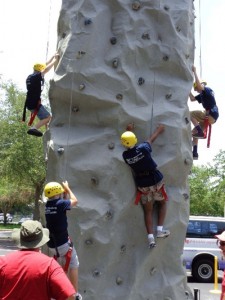
Students participate in a rock wall climbing exercise to better understand the physical challenges faced by law enforcement.

Students got to spend time with SPC Law Enforcement Academy recruits and learned firsthand what it is like to train as a law enforcement officer. Students learned about the physical requirements for a career in public safety and how to overcome challenges through a rock wall climbing experience.

Speakers at the camp included St. Petersburg Police Chief David DeKay, Director of Urban Affairs for the City of St. Petersburg Nikki Gaskin-Capehart and Executive Director of SPC’s Center for Public Safety Innovation Eileen LaHaie. The three discussed the importance public safety plays in the community and how campers would interact with public safety professionals during the summer camp.

The camp also included several field trips to the:

  • St. Petersburg Police Department
  • Pinellas County Justice Center
  • St. Petersburg Fire Department

“I loved the field trips,” said camper Anthony Massa, 12. “We got to see some interesting places and see what those jobs were like.”

The week-long camp culminated in a graduation ceremony where campers received certificates of completion. All of the parents surveyed indicated that the summer camp was a great experience for their children and 96 percent of the students would recommend the camp to their friends.

Several agencies were contributed to this year’s summer camp:

  • Pinellas County Campus Police
  • Pinellas County Sheriff’s Office
  • St. Petersburg Police
  • St. Petersburg Fire Department

Performance enhancing drugs in sports

Is it ethical to use performance enhancing drugs in sports? This was the question posed to a panel of local experts for the Applied Ethics Institute’s most recent ethics forum on April 2, 2013 at St. Petersburg College/Gibbs campus.

Dr. Michael J. Smith, Mark Strickland, and Frank Murtha are panelists for an Ethics Forum on Performance Enhancing Drugs at St.Petersburg College.

Frank Murtha, an attorney and sports agent, Dr. Michael J. Smith, a sports medicine doctor, and Mark Strickland, SPC’s athletic director and associate provost of the downtown campus, answered questions posed by ethics Professor David Monroe and the audience.

Team doctors for professional sports teams are under strong ethical pressures from the athletes, the team owners and the fans to do whatever is necessary to get an athlete ready to play as soon as possible when they are injured. When they are healthy, they may use performance enhancing drugs to even the playing field.

“Fans want to see their stars play. Fans want their team to win. But fans need to understand there are risks for the athletes if they play injured,” says Murtha.

Dr. Smith says a physician has to determine what is right for the athlete even though the physician is paid by the team. This tension between the demands of the owners and the interests of the fans can be in conflict with the best interests of the athlete. “As a physician, I have to do what is right for the athlete,” says Dr. Smith.

Murtha pointed out that the minimum salary for an NFL player is now about $500,000 a year. Players making the least amount of money will do whatever it takes to be healthy and to qualify to play so they can continue to earn money during their short careers. Murtha summed the dilemma up with an NFL aphorism: “You can’t make the club in the tub. If you’re injured, you can’t play.” He says athletes frequently use medication to get through the pain because they are under so much pressure to play even when they are injured. “There’s no gold watch for retired athletes,” says Murtha, “So athletes play injured to keep getting paid.”

Dr. Smith remembers when he was a student athlete and he noticed some of his fellow athletes bulked up by using steroids. He visited his family physician and asked for a prescription for steroids. His physician told Dr. Smith that with every drug, there are side effects. His doctor pulled out his Physicians Reference Guide and read to Dr. Smith that the side effects of the steroid were acne, hair loss, testicular atrophy…. and Dr. Smith chose to forego the steroids. “There’s no governing body or ethical committee saying who can make designer or performance enhancing drugs; but my doctor delivered me and cared enough about me as a young man to give me good ethical advice.”

Student athletes at St. Petersburg College are random tested for performance enhancing drugs twice a year. Strickland says steroids are not a big factor at the college but SPC does maintain a small budget (less than $20,000) for drug testing. “Instead of relying on tests, we make close relationships between the team members and our coaches. Because we know our athletes, we can steer them in the right direction,” says Strickland.

It is in the athlete’s own best interests to maintain a healthy lifestyle free of drugs. Murtha points out that today’s performance enhancing drugs are much more sophisticated than in years past. “The side effects can go beyond the usual impacts to include weight loss, cancer, aberrant behavior, overdoses and death.”

Dr. Smith says professional athletes and team owners are much more aware of the problem of concussions and may blame aberrant behavior on a concussion. But sometimes the aberrant behavior is from drug use. Murtha says the downside of performance enhancing drugs “may not be immediate, but down the road, it catches up with you.”

More information about the Applied Ethics Institute.

An ethics perspective on performance enhancing drugs.

We touched the moon!

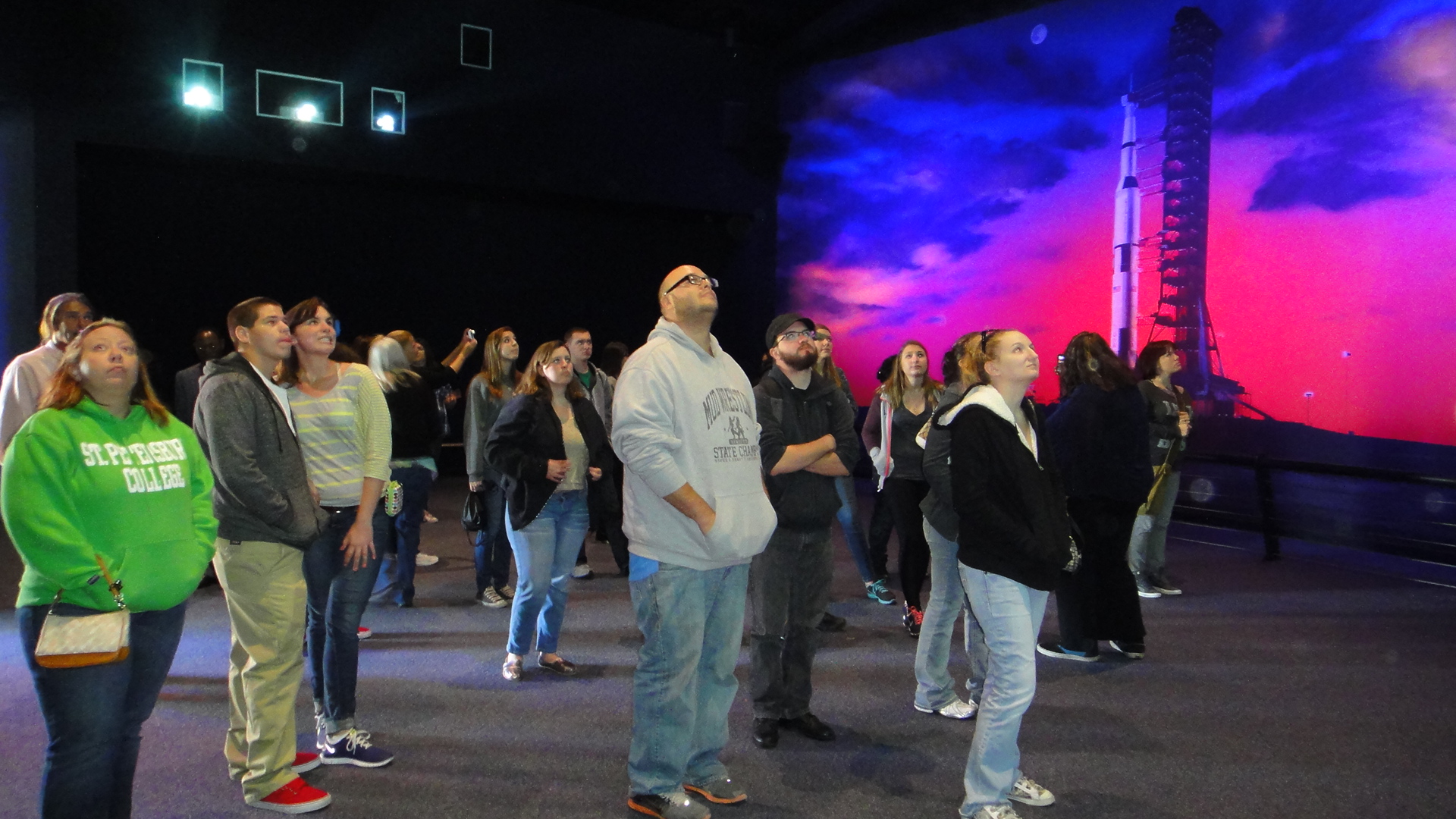
SPC ethics students watch the Kennedy Space Center movie about man’s landing on the moon.

Few of the 27 St. Petersburg College ethics students who traveled to the Kennedy Space Center on Feb. 15 knew they would experience a simulated launch, talk to an astronaut, stand near the space shuttle launch pad, tour the Vehicle Assembly Building or touch a moon rock … but these were just a few of the experiences made available to them during their up close and personal tour of NASA.

Student Kyle Harriot called the visit emotional. “I loved watching the space shuttle launches from my front yard at my house, and now that it is gone, it seems very quiet there,” he said. Harriot called the simulated space launch his favorite activity because “now I know what it feels like to lift off from an actual space shuttle.”

Yadira Sierra said the visit to the Space Center was emotional, inspiring and educational. She said she had “this huge sense of pride … because I am an American; I’m a citizen of such a savvy and intellectual nation, and one day one of my kids could be the one building these rockets…
what a wonderful feeling!”

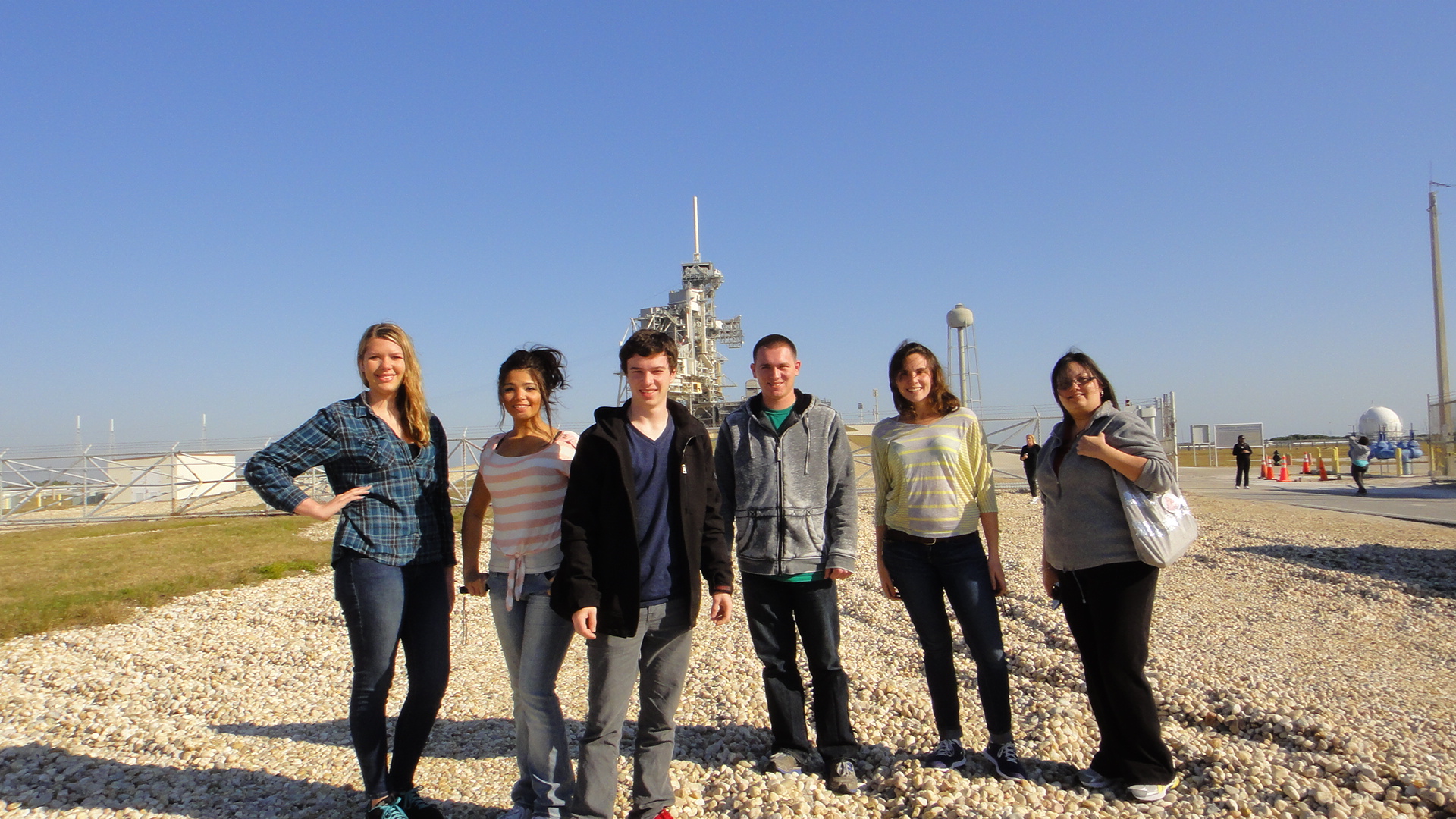
St. Petersburg College ethics students stand in front of the space shuttle launch pad at the Kennedy Space Center. Students are Chelsea Carrington, Chelsea Luna, Jared Dehn, Kyle Harriott, Brooke Buckle and Yadira Sierra.

Bobby Finn was fascinated with “expansive, gorgeous Cape Canaveral” but pointed out the student camaraderie was perhaps the best part of the field trip. He said he noticed during the trip home from NASA that “the jocularity, banter and eager communication among the birthing of new friendships formed was a stark contrast to the silence of the pre-dawn trek across state. It is activities such as these that last a lifetime in the memories of our young … leaders of tomorrow.”

“If I were offered to go on this trip again, I would immediately say yes and register,” Harriott said. “This trip was so much fun and I learned so many different things. This is by far my favorite field trip ever in college.”

The NASA field trip was organized for ethics students by Dr. Adeniji Odutola, Chair of the Ethics Department, and sponsored by the Ethics Department. Dr. Odutola organized the trip based on his experiences traveling with SPC education students. He hopes to offer the field trip to ethics students during future fall and spring semesters.

For more information, visit Kennedy Space Center. For a video about
the space center, visit Youtube. For more information
about the future of NASA space exploration, visit How to get to Mars.